The Post-Prompt Paradigm: How Autonomous Multi-Agent Architectures Are Rewiring Enterprise Software
Why single-turn prompt engineering has hit an architectural plateau, and how asynchronous agent swarms with shared blackboard memories are replacing human glue work.
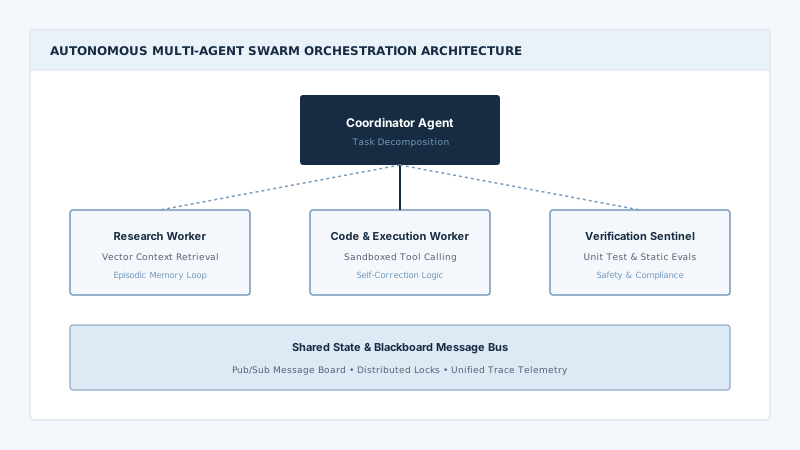
Figure 1: Coordinated multi-agent topology showing coordinator decomposition, domain workers, and verification loops.
Key Findings & Architecture Notes
- •Single monolithic prompts suffer severe attention attenuation over long token contexts, cascading initial hallucinations into production crashes.
- •Modern architectures partition responsibility across three distinct roles: Coordinator, Specialized Workers, and Verification Sentinels.
- •Shared blackboard message buses allow asynchronous subagents to collaborate without saturating individual context windows.
- •Deterministic code evaluation (unit tests, static linters, sandbox execution) is mandatory to ground probabilistic model outputs.
- •Intelligent model routing directs 80% of routine categorization to lightweight models, reserving frontier reasoning models for coordination.
Monolithic Prompting vs. Multi-Agent Swarms
| System Dimension | Monolithic Prompt | Coordinated Multi-Agent Swarm |
|---|---|---|
| Context Management | Rapid saturation; lost constraints. | Segmented, highly focused per-role context buffers. |
| Error Recovery | Hallucinations compound down the token stream. | Verification agent halts bad code before commit. |
| Cost & Latency | Every step runs through maximum-cost model. | Lightweight models handle classification; frontier model plans. |
The Limits of Monolithic Prompt Engineering
For three years, the industry attempted to solve increasingly complex engineering tasks simply by expanding LLM context windows from 8k to 128k, and then to multi-million token windows. Yet software engineers discovered a frustrating reality: having a vast context window is not the same as maintaining coherent reasoning across twenty sequential decisions.
As context windows bloat with logs, code files, and user instructions, attention mechanisms suffer from attenuation. Crucial constraints are overlooked, and early hallucinations cascade down the token stream. The solution is architectural: rather than one agent attempting everything, we assemble focused, decoupled agents collaborating across structured communication channels.
The Coordinator-Worker-Verifier Pattern
Production multi-agent topologies typically implement a three-tier separation of concerns: The Coordinator decomposes the high-level objective into an executable graph; Workers execute isolated tasks in sandboxed sub-environments; and Verification Sentinels run automated tests and static analysis before allowing changes into main code branches.
Subject Index
About Elena Rostova
Lead Systems Engineer & AI Systems Researcher • New York / Berlin Bureau
Elena Rostova specializes in distributed microservices, web standards, and autonomous multi-agent AI architectures. She previously led frontend systems engineering at high-growth European tech ventures and writes on agentic workflow protocols.