Agentforce Explained: Features, Architecture and Use Cases
How the Atlas Reasoning Engine, Data Cloud Grounding, and Autonomous Action Libraries Are Redefining Enterprise Operations.
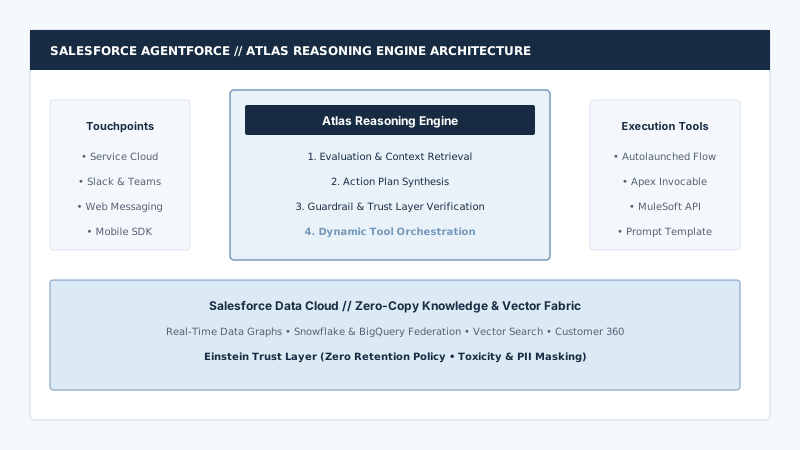
Figure 3: Salesforce Agentforce, Atlas Reasoning Engine, and Einstein Trust Layer architecture.
Key Findings & Architecture Notes
- •Agentforce marks the evolution from passive text generation (Copilot) to autonomous action orchestration (Atlas Reasoning Engine).
- •Agents operate on a continuous loop: evaluate contextual intent, retrieve grounded data, synthesize an action plan, verify guardrails, and execute tools.
- •Salesforce Data Cloud provides zero-copy real-time data federation (Snowflake, BigQuery, AWS Redshift) to prevent hallucinations.
- •Actions are implemented using standard Salesforce building blocks: Autolaunched Flows, Invocable Apex methods, and MuleSoft API endpoints.
- •The Einstein Trust Layer enforces strict data privacy, enterprise-grade zero retention agreements, and prompt toxicity filters.
Inside the Atlas Reasoning Engine
At the center of Agentforce is the Atlas Reasoning Engine. Unlike simple LLM wrappers that invoke functions through basic few-shot examples, Atlas executes an autonomous operational loop: Intent Recognition → Grounded Retrieval → Action Plan Synthesis → Guardrail Validation → Execution.
Building Invocable Apex Tools for Agentforce
public with sharing class CustomerHealthService {
    public class Request {
        @InvocableVariable(label='Account ID' required=true)
        public Id accountId;
    }
    public class Response {
        @InvocableVariable(label='Health Status')
        public String status;
    }

    @InvocableMethod(label='Evaluate Customer Health')
    public static List<Response> evaluate(List<Request> requests) {
        List<Response> responses = new List<Response>();
        for (Request req : requests) {
            Response res = new Response();
            res.status = 'Healthy';
            responses.add(res);
        }
        return responses;
    }
}
Subject Index
About Kenji Sato
Enterprise AI Architect & Salesforce MVP • Tokyo Bureau
Based in Tokyo, Kenji Sato consults on enterprise AI agent deployment, Salesforce Data Cloud federation, and autonomous business process automation across APAC and North American enterprise organizations.