Lightning Web Components: A Complete Beginner's Guide
Building Modern, Reactive, and Accessible Enterprise User Interfaces on the Salesforce Platform Using Web Standards.
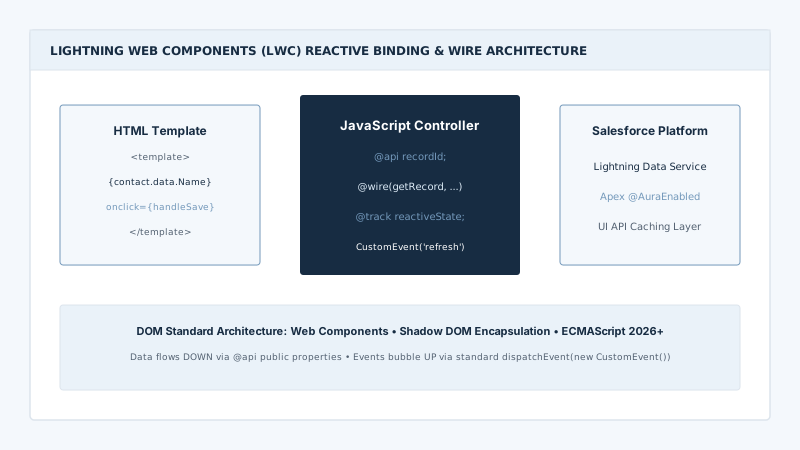
Figure 6: Component encapsulation, reactive decorators, and Wire Service adapters in LWC.
Key Findings & Architecture Notes
- •LWC is built on native W3C Web Component standards, eliminating proprietary framework baggage and delivering superior browser performance.
- •Utilize the @api decorator for public reactive properties, and standard class fields for internal component reactivity.
- •Leverage the Wire Service (@wire) and Lightning Data Service (LDS) for declarative caching and automated cache invalidation.
- •Follow the standard event pattern: pass properties down to children via attributes, and bubble events up to parents using CustomEvent.
Web Standards Over Proprietary Frameworks
Lightning Web Components relies directly on native browser capabilities: Custom Elements, Shadow DOM, templates, and ES modules. The result is a lightweight runtime engine that executes significantly faster and uses less client memory.
Subject Index
About Elena Rostova
Lead Systems Engineer & AI Systems Researcher • New York / Berlin Bureau
Elena Rostova specializes in distributed microservices, web standards, and autonomous multi-agent AI architectures. She previously led frontend systems engineering at high-growth European tech ventures and writes on agentic workflow protocols.