Modern Software Architecture: Designing Resilient Distributed Systems
Engineering Distributed Systems That Degrade Gracefully: Event Streams, Idempotency Guards, and Resilient Microservices.
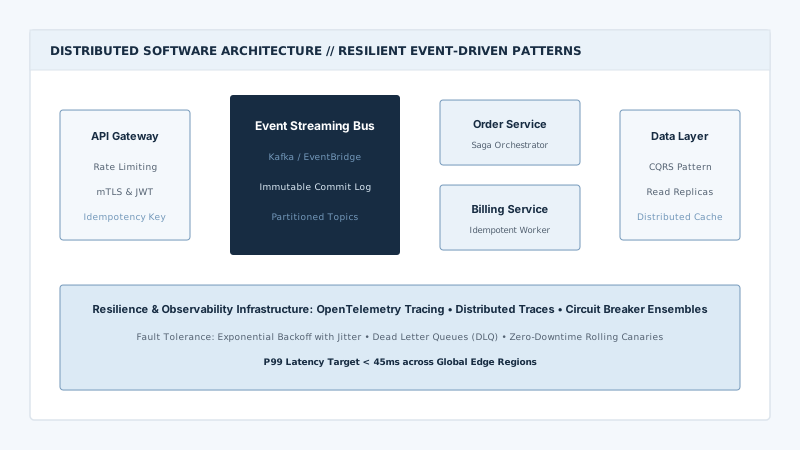
Figure 5: High-throughput event-driven microservices topology with CQRS, circuit breakers, and distributed tracing.
Key Findings & Architecture Notes
- •Synchronous RPC calls between microservices create fragile dependency chains where one latency spike cascades across the entire platform.
- •Adopt event streaming (Kafka, AWS EventBridge) to decouple producer throughput from consumer execution speed.
- •Every mutating API endpoint must enforce unique Idempotency-Keys to safely handle automated client retries.
- •Deploy circuit breakers (e.g., Resilience4j, Envoy) to quickly fail fast and shed load when a downstream service degrades.
- •Implement OpenTelemetry distributed tracing from the edge API gateway through all internal worker queues.
The Fallacy of Distributed Computing
In modern multi-region cloud deployments, networks partition regularly, DNS lookups stall, and third-party SaaS APIs suffer intermittent 502 errors. If your architecture assumes every component will answer synchronously within 100 milliseconds, your entire platform will collapse under peak load. Resilience is not the absence of failure—it is the systemic ability to degrade gracefully while preserving core transactional integrity.
Subject Index
About Kenji Sato
Enterprise AI Architect & Salesforce MVP • Tokyo Bureau
Based in Tokyo, Kenji Sato consults on enterprise AI agent deployment, Salesforce Data Cloud federation, and autonomous business process automation across APAC and North American enterprise organizations.